
Category: Burnout

  • Later is Too Late

    Later is Too Late

    I’ll get to it later, I have time” was a very seductive lie I told myself throughout my tenure as a CEO. I would get in great shape when my net worth hit X and I would hire a personal trainer, I had time. I would enter a meaningful, heartfelt relationship when the executive team could run the day-to-day without me, I had time. I would learn guitar (for my third attempt) and record my music, I totally had time. I’d start a family, plenty of time for that. I would spend more time doing what I loved.

    I believed that circumstances would one day align when my calendar and bank account finally cooperate – which makes me chuckle now writing that. Over 17 years as a Founder and CEO, I paid the price for putting my dreams off, despite a lot of financial and outward success. And life looked as such for other founders in my network. They were gaining unwanted weight, getting depressed, withdrawn, cynical, divorced and disconnected from the vibrant life force that got them into entrepreneurship in the first place. And the companies were struggling, stagnating and the exit strategy had become a mirage.

    As is the case, most leaders survive on deferred maintenance. Founders have normalized it. Executives institutionalized it. The drift away from what matters most is subtle, but the cost is absolute and very palpable.

    The things that matter most – health, relationships, creativity, meaning – generally do not collapse suddenly. They erode. They degrade not through crisis, but through postponement. Health withers, relationships drift while purpose dissolves into mere output. It happens via the quiet internal whisper that says “I’ll tend to this when things calm down. When the product ships. When the round closes. When my net worth hits X.

    But that is not valid reasoning, it is a protective narrative hard at work. It is a psychological veil that shields you from confronting old beliefs you were trained to obey – beliefs about worth, safety, and what you’re truly allowed to experience out of life. I wore that veil for many, many years.

    Because “later” is a soothing anesthesia.

    It lets you avoid the exploration with the part of you that is afraid of deep change, afraid of your heart’s calling, or afraid of taking yourself and your life’s purpose very seriously.

    But anesthesia always has an invoice.

    You think you are investing in a better future as a leader, but you are making payments to your past.

    “Later” compounds over time. Like interest on a loan, the cost rises quietly until one day the beliefs that no longer serve you have foreclosed on your dreams.

    It’s commonplace that we discover these insights too late. The old stories of waking up to symbols of success with no meaning, no vitality and often depressed. So many founders and executives feel it as an inescapable fatigue, a hollowing gap between external success and internal stagnation. They assumed life would expand when success did. It didn’t for me and many in my entrepreneurial circles. It never does. The outside scales. The inside does not — unless you proactively work on it.

    If you want a life you enjoy later, the only material you will ever have to build it with is how you act today. Not when you feel ready, not when the company stabilizes, and not when you have more money or more confidence.

    Working on managing the psyche is the only point of leverage we have. It is the only environment where change is real rather than conceptual. Because we do not see things as they are, rather we see things as we are. And if what you see is no longer serving you, well.. what are you going to do with that awareness?

    Whatever can be done about it is probably going to require ongoing support and resources to make a lasting impact. For me, it was having someone trusted and experienced in my corner – and it still is.

    The work we do is not about forcing discipline. It is about dissolving the beliefs that keep you postponing your own high quality life and the success of your entrepreneurship. It is about identifying and growing out of the narratives that once kept you safe but now keep you stagnant. The coaching work we do together is to interrupt the automatic payments you keep making to your past and start cultivating the life you do want and deserve.

    Later is too late. Your future is shaped only by what you intentionally put into practice today.

    If you are feeling called to explore deeper, I’d welcome getting to know you.
  • Feeling Founder Burnout

    Feeling Founder Burnout

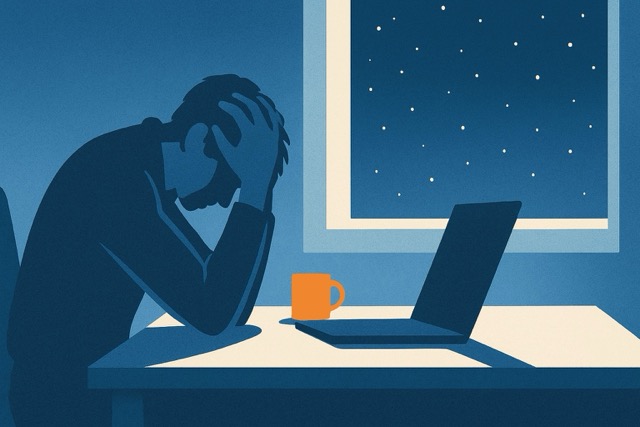
    It’s been a little over a decade now, but I still remember all too well when I was burnt out. I don’t even like to talk about it, let alone sit here to write about it. It was an ongoing fatigue that sleep would not cure. Company was doing well and yet it was no reward. I was drained, work kept piling on and I didn’t know what life was about other than trying to clear my damn inbox. The company was growing while employee morale was dwindling away. It was a nightmare straight out of Groundhog’s Day and I just kept pushing forward because that had always been my answer to everything. Discipline. Endurance. Output.

    Somewhere along the way, what was once a passionate and life-affirming entrepreneurship journey had started becoming soul-sucking experience that I desperately wanted out of. I had dreams of crashing a plane into a moutain. I wasn’t even 35 yet.

    At the time, it did not look like burnout. On paper, things were working. Deals closed. Teams moved. Projects delivered. KPIs good. Everyone was heads down, working. My days were filled and accounted for to the minute. But burnout rarely announces itself in the KPIs. It hid behind my competence. I kept producing because I didn’t know anything else, even as my body and life were sending signals of burnout.

    You tell yourself relief will come after the next milestone, the next quarter, the next round or that elusive exit. I know now that relief and clarity never arrives on its own. It has to be deliberately designed into the system. Left unattended, burnout simply becomes a founder’s operating environment.

    The first thing burnout distorted was my decision making.

    I became narrower. Less curious. More reactive. Far more curt. Decisions optimized for my short-term relief rather than long-term vision. I deflected complex conversations because they felt heavy. I delayed strategic choices because I did not trust my own energy to see them through. Risk tolerance became like gambling at a casino. Some days I played it too safe, protecting myself from more load. Other days I took unnecessary risks out of quiet desperation, hoping momentum would shake something loose and I would find relief.

    Company culture soon followed. Later I would learn that when a leader is burnt out, the organization feels it and absorbs it, whether they intend to or not. I became less present – hiding behind monitors at my home-office. Less available. Meetings shortened not out of efficiency but out of depletion. Patience thinned. I still cared, but care without energy and clarity translates poorly. Teams sense when decisions are made from survival instead of vision. Over time, that shows up as hesitation, second-guessing, and quiet disengagement. Our once-thriving company culture slowly disintegrated into something I don’t even have great words for… good people quit, the wrong people stayed.. etc etc. ufff.

    I tried taking weeks off. Many times. Trips to Japan did not help. Neither did saunas, meditation, nor self-help books. I didn’t realize it then, but the problem was not tiredness. It was disconnection from purpose. Time away, followed by a return to the same incentives, the same internal pressure, the same unresolved questions, only reinforced my loop. It took years to realize rest without redesign of my life and habits just reinforced the burnout loop. What I needed was not another getaway. I needed honesty – about what was fueling me, and what was quietly consuming me.

    Burnout thrives on avoidance and aloneness.

    Avoidance of discomfort. Avoidance of parts of ourselves neglected. Avoidance of the question underneath all the motion. Why am I doing this in this way? And no one appropriate to talk to. Friends just sympathized and patted me on the back that I was a CEO and doing well. Therapy was helping my soul but not helping how I ran the business.

    The shift for me began slowly when I began to reveal how I’m feeling to my mentor – a former C-level at Mattel & IBM, turned coach and confidant. I had never shared so deeply with him before, it had mostly just been conversations on driving revenue and scale. We were having lunch at Killer Shrimp in Marina Del Rey. He shared that I should turn towards the signals of my burnout and start listening to it. He shared his own struggles with burnout at Mattel back when they were launching one successful toy after another in the 70s and 80s. Back when they built toys to last using die cast metal, he would say often. With his council and ongoing support, I stopped asking how I can push through and started asking what is this trying to tell me. That question opened something within me and opened a pathway. Over time and with work with my coach, exhaustion stopped being an enemy to fight and became a signal to tune-in to. Awareness replaced brute force. And that awareness, applied consistently, opened the door to purposeful actions. All of this possible because I truly opened up to my mentor and had regular dialogue with him and began to do the work needed.

    Getting help was not passive nor vague. It was uncomfortable at first.

    He asked me key questions I would never have considered on my own, recommending I sit down and write out my responses in detail.

    Working with my mentor meant slowing down enough to examine the stories I had been running for years. Stories about responsibility. Long held beliefs I had adopted, like “If you want something done right, you gotta do it yourself.” About self-worth being tied to output. About rest being earned rather than deserved and required. I used to have a magnet on my fridge I was proud of that read “I’ll sleep when I’m dead.” I threw it in the trash. Being coached, for me, looked like rigorous reflection paired with accountability. It meant tracing patterns across decades of my life, often back to my childhood. It meant recalling how influential my father’s voice had been when he had said just once “I don’t care what you do with your life so long as you make money.” It meant redesigning the company to be aligned with my values instead of habits.

    Practically, it changed how I worked. Clearer boundaries. Fewer priorities. Decisions made earlier instead of postponed. Delegation that was real, not deflection. Whereas I used to make nearly all the decisions, I worked with our team to empower them all to make their own decisions in their capacity.

    I let go of a lot of control I never should have had in the first place.

    Space built into the calendar not as recovery, but as part of the work itself. No more meetings for me before 11AM. There were plenty of talented people in the company to handle daily small fires and get to resolution. Internally, it meant tolerating unease instead of numbing it with KPI analysis on dashboards. My NASA resembling dashboard got redesigned as well, down to just 3 metrics. Letting go of identities that were no longer serving me – tough one but ultimately very rewarding. Redefining success as something sustainable, repeatable, and meaningful.

    This did not happen quickly. It was built steadily over years. But the result was a life and career that felt stable, peaceful, and successful in a way that was lasting. Burnout faded away like a smoldering fire that quietly extinguished itself because I was no longer ignoring its signals and had learned to attune and tend to those signals as a means to serve my purpose in life.

    I retained my position as CEO and later sold the company to private equity – something I highly doubt could have happened as well as it did, if I had been operating under burnout.

    If you are experiencing similar signals, invite yourself to take a pause. Step away from the next task. Do not ask what you need to finish. Ask what you need to feel whole again right now. That is where it began for me and what I work to pay-forward to the lives of other founders and CEOs. Working with my mentor became a very meaningful journey that uplifted my career to where I had envisioned it back in my 20s.

    If you could use more support, it is not weakness, and maybe it’s a sign to explore coaching with someone you feel comfortable with.

  • Later is Too Late

    Later is too late. Learn what it takes to cultivate the life you want now without waiting for…

    Later is Too Late
  • Feeling Founder Burnout

    It’s been a little over a decade now, but I still remember all too well when I was…

    Feeling Founder Burnout